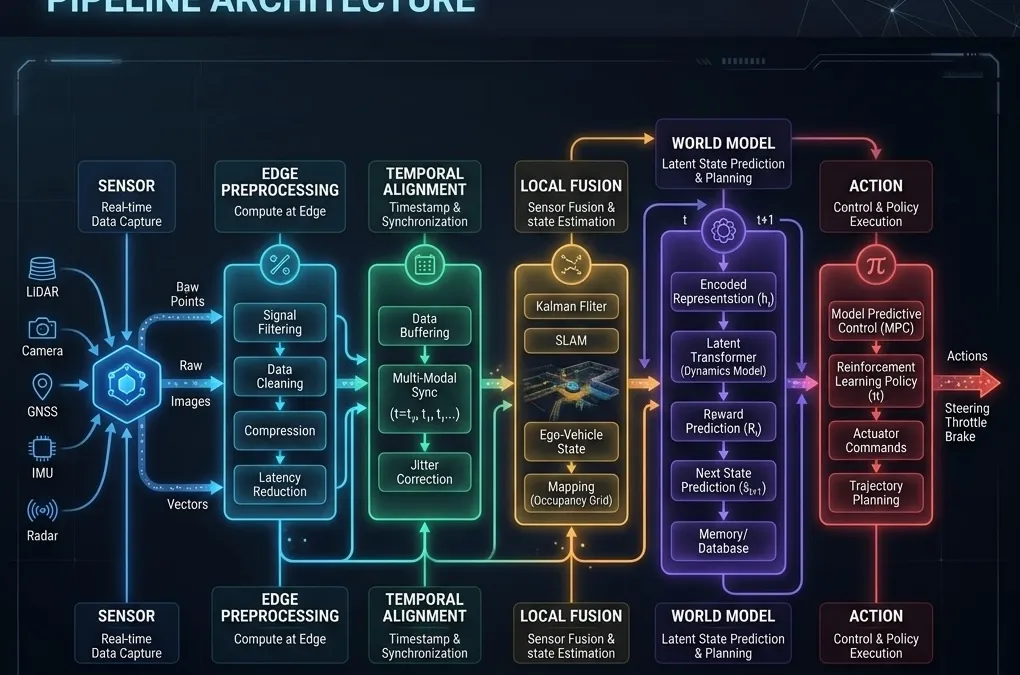
“If data is the new oil, World Models are trying to drink from the firehose of a deep-sea rig. And our current infrastructure simply isn’t built for that pressure.”
In Part 1, we explored why World Models—systems designed to intuitively understand and predict the physical world—are the next massive frontier beyond Large Language Models. We discussed how moving AI from text boxes to physical environments requires teaching machines “physics.”
But there is a catch. A massive one.
While the algorithms to create World Models are advancing rapidly, the systems engineering to feed them is hitting a brick wall. We call it the Data Ingestion Wall.
1. The Anatomy of the Wall
To understand why this wall exists, we have to look at how different text is from reality.
When you train or run an LLM, the data is discrete and relatively slow. Even a massive Wikipedia dump is just a collection of characters. A 1,000-word prompt is computationally negligible to transmit.
Now, look at the sensory array of a single autonomous robot navigating a warehouse:
- Multiple 4K Cameras: A few high-resolution cameras can already generate multiple gigabits per second of raw sensor data.
- LiDAR & Depth Sensors: Adding spatial mapping can push the aggregate raw sensor bandwidth into the multi-gigabyte-per-second range.
- IMUs (Inertial Measurement Units): Streaming balance and acceleration data at 1,000+ times a second.
- Actuator Telemetry: Measuring torque and resistance on every joint in real-time.
This isn’t an ETL (Extract, Transform, Load) problem where you can run a batch job overnight. This is a continuous, multidimensional stream of reality.
The Data Ingestion Wall is built on three pillars of failure in traditional infrastructure:
The Synchronization Challenge
If a robot’s left camera captures an obstacle at T=1.002s, while the corresponding right-camera observation represents T=1.040s, the World Model may fuse observations describing different physical states. For fast-moving objects, even a few milliseconds of temporal misalignment can distort the reconstructed scene. The model isn’t hallucinating in the LLM sense; it is being handed a physically inconsistent observation.
The Bandwidth Paradox
You cannot send all this raw telemetry to remote cloud infrastructure. Even with 5G or Wi-Fi 7, the physics of latency, bandwidth, and reliability make sending the complete raw sensor stream to a distant cloud impractical for real-time physical reaction. You are generating massive data per machine, and a fleet of 100 robots can quickly overwhelm the available uplink capacity of a conventional centralized architecture.
The Unstructured Chaos
Text is structured. Relational data is structured. Real-time multimodal sensory streams are chaotic. Decoding video, aligning point clouds, and mapping time-series sensor data simultaneously requires massive compute overhead before the AI model even sees the first byte.
2. The Fundamental Shift: From Data to Reality Streams
Traditional distributed data systems typically optimize for throughput, availability, durability, and eventual processing—not for preserving a precisely aligned temporal snapshot across heterogeneous physical sensors.
We need to shift our architectural mindset.
The Information Bottleneck
The goal isn’t to move all the data. The goal is to move the right information, at the right time, with the right temporal context.
A World Model doesn’t necessarily need every pixel from every camera at every instant. It needs the right information, with the right temporal relationship, at the right latency. The infrastructure must preserve the information required to reconstruct the relevant physical state while aggressively eliminating irrelevant information.
Temporal Semantics
In conventional data pipelines, an event has a simple timestamp. In physical AI, a camera frame isn’t simply bytes. It’s an observation heavily dependent on its context:
| Field | Purpose |
|---|---|
sensor_id |
Identifies the physical source |
capture_timestamp |
The exact hardware time of capture |
clock_domain |
The synchronization context |
frame_id / sequence |
Ordering within the stream |
pose / calibration |
Spatial alignment metadata |
uncertainty |
Confidence bounds of the reading |
payload |
The actual sensor data bytes |
| This requires “temporal semantics” as a first-class concept throughout the pipeline. |
Local Fusion
Once observations are temporally aligned, they still need to be spatially and semantically fused. Camera frames, LiDAR point clouds, IMU measurements, and actuator telemetry describe different aspects of the same physical state. The ingestion layer therefore becomes more than a transport mechanism—it becomes the first stage of constructing a coherent representation of reality.
Latency Budgets
A physical AI system doesn’t have a single latency requirement. It has a latency budget. For example: sensor capture → synchronization → preprocessing → perception → world-model inference → planning → actuation. If the total budget is 50 ms, spending 20 ms simply moving data between processing stages is already consuming 40% of the available reaction time. End-to-end latency is fundamentally different from just network latency.
3. Breaking the Wall
To build infrastructure for World Models, we have to fundamentally re-architect how data flows from the physical sensor to the neural network.
Edge Preprocessing & Information Filtering
We can no longer afford to “store everything and process it later.” The infrastructure must discard redundant or low-information observations before they traverse the network. For instance, in a largely static scene, an edge filter might eliminate a substantial fraction of redundant frames, drastically reducing the bandwidth overhead without sacrificing critical state information.
Deterministic Networking
To solve the synchronization and latency challenges, deterministic networking and precise time synchronization become crucial. Together, these technologies provide precise clock synchronization, bounded latency, deterministic traffic scheduling, and accurate hardware-level timestamping—foundations for maintaining temporal consistency across the sensor pipeline.
Zero-Copy and Direct Memory Access
When data arrives at the compute node, unnecessary movement across the CPU and memory hierarchy can become a significant bottleneck. We must minimize copies across the ingestion path using DMA, pinned buffers, RDMA (Remote Direct Memory Access), and, where supported, GPU-direct technologies such as GPUDirect RDMA. The goal is to move sensor data from the NIC toward accelerator memory with as few CPU-mediated copies as possible. Separately, for the analytics or training pipeline, specialized columnar formats like Apache Arrow become critical.
4. The New Blueprint
We are adding a new architectural paradigm alongside data warehousing: Reality Streaming.
The cloud isn’t disappearing. Its role is changing. The reaction loop moves toward the edge, while the learning loop continues to leverage centralized infrastructure.
flowchart LR
    %% Professional High-Contrast Solid Styles
    classDef default fill:#1E293B,stroke:#94A3B8,stroke-width:2px,color:#F8FAFC,rx:6px,ry:6px
    classDef edgeNode fill:#1E3A8A,stroke:#60A5FA,stroke-width:2px,color:#EFF6FF,rx:6px,ry:6px
    classDef realTime fill:#064E3B,stroke:#34D399,stroke-width:2px,color:#ECFDF5,rx:6px,ry:6px
    classDef storage fill:#4C1D95,stroke:#A78BFA,stroke-width:2px,color:#F5F3FF,rx:6px,ry:6px
    classDef worldModel fill:#7F1D1D,stroke:#F87171,stroke-width:2px,color:#FEF2F2,rx:6px,ry:6px

    linkStyle default stroke:#64748B,stroke-width:2px,color:#F8FAFC

    S[Sensors]:::edgeNode --> E[Edge Preprocessing]:::edgeNode

    %% Real-time Path
    E -->|Real-time Path| TS[Temporal Sync]:::realTime
    TS --> LF[Local Fusion]:::realTime
    LF --> WM[World Model]:::worldModel
    WM --> A[Action]:::worldModel

    %% Data/Training Path
    E -->|Data/Training Path| ST[Storage]:::storage
    ST --> TR[Training / Simulation]:::storage
    TR -.-> WM
The engineers who will build the next decade of foundational AI infrastructure aren’t just writing SQL or configuring Kubernetes clusters. They are building deterministic, bounded-latency, high-bandwidth pipelines that connect the physical world to silicon brains.
If you can crack the Data Ingestion Wall, you don’t just move data faster. You reduce the distance—physical, temporal, and computational—between reality and the model trying to understand it.
And that distance may become one of the defining infrastructure constraints of Physical AI.
What’s Next in This Series?
This architectural split naturally leads us to our next critical questions:
- Part 3: Where computation should happen (Edge vs. Cloud).
- Part 4: How the network must change to support Physical AI latency demands.
- Part 5: Storage and training infrastructure for World Models.
What do you think? Are your current data pipelines ready to handle continuous, synchronized multimodal streams? Let’s discuss in the comments.